Region Kalmar County hold talks in Brussels on circular water use in northern Europe
On the 6 of November, Region Kalmar County, together with other members of the Interreg project WaterMan, organised a roundtable discussion in Brussels on circular water use in Northern Europe. In addition to the project participants themselves, the event brought together important actors from the regional and national levels around the Baltic Sea region, as well as universities and influential European interest groups. The focus of the event was to summarise and disseminate the knowledge accumulated by the project and how it can be used at the local and European levels. As part of this, the project’s toolbox for water reuse was presented, along with concrete input to the European Commission ahead of a forthcoming review of the Water Reuse Directive. Read on for more information about the event and Region Kalmar County’s role in the WaterMan project.
Background
Since the newly appointed European Commission was sworn in last December, water resilience has been identified as a specific strategic priority for Europe. Alongside flooding, drought and water scarcity have long been seen as an issue mainly in southern European countries, but in recent years they have also attracted increasing attention in more northern latitudes. Not least in the south-east of Sweden, which has experienced a growing problem with shortages in water resources. This problem is expected to worsen as climate change intensifies.
One effective way to tackle these issues is through the reuse of water, which is encouraged by new European legislation and initiatives. Examples include the EU Regulation on minimum requirements for water reuse (EU)2020/741 and the European Commission’s new strategy for water resilience (COM(2025)280). While continued research and knowledge in these areas is important, there is also a need to compile existing knowledge and test different types of solutions in practice.
Project WaterMan
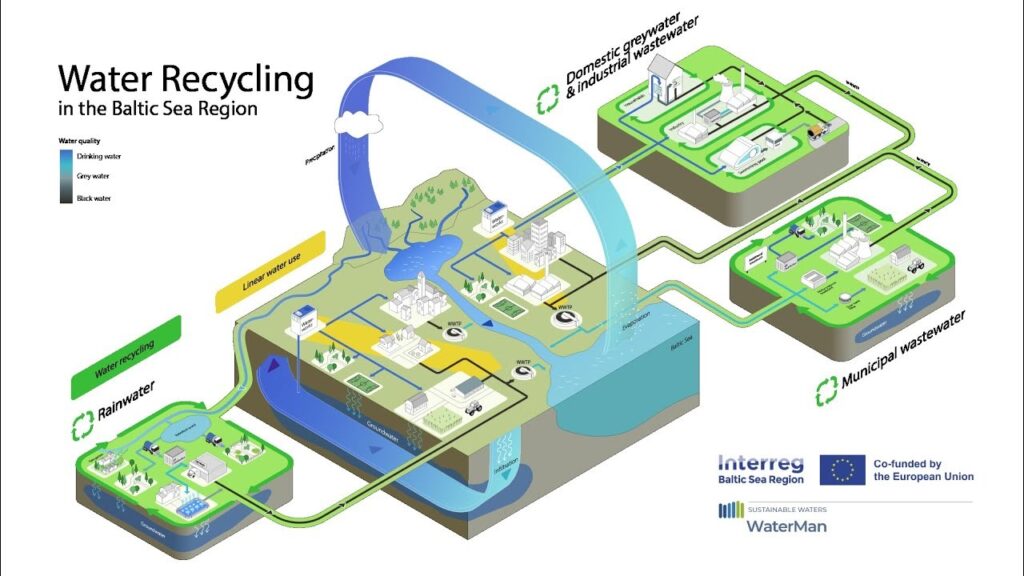
The needs described above is the main focus of the WaterMan project led by Region Kalmar County. WaterMan is an EU-funded project within the framework of Interreg’s Baltic Sea Programme and consists of 17 actors from the Baltic Sea region who want to work together to combat water shortages and contribute to long-term sustainable water supply in northern Europe. Among other things, the project has focused on finding and implementing practical methods for water reuse at the local level and disseminating these through, for example, a digital toolbox. Some of the methods that have been of particular interest to the project are how the reuse of municipal wastewater and micro-loops, which circulate water of different qualities within households and industrial facilities, can be combined with methods for retaining and delaying rainwater in the landscape.
In addition to the practical implementation of pilot projects and test measures, the project has held several dialogue sessions with the aim of, among other things, discussing and providing the European Commission and other relevant actors with concrete input for the upcoming review of the EU Water Reuse Directive in 2028. Two roundtable discussions were organised in Brussels in 2025, the last of which took place on 6 November 2025.
Roundtable discussions in Brussels
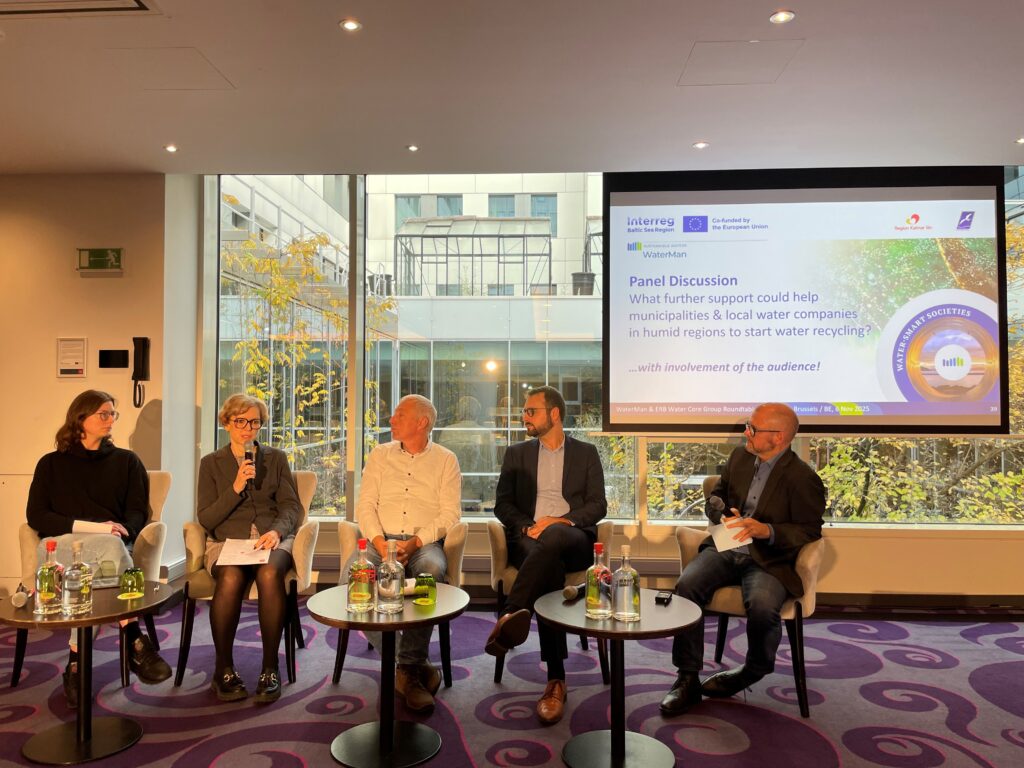
The title of the discussion was Water recycling as a cornerstone of resilient water supply in humid regions? – Practical lessons learnt in the WaterMan project and conclusions for future policies in the EU. Participants, both physical present and online, included several important actors from regional and national levels around the Baltic Sea region, as well as universities and influential European interest groups.
One of the invited speakers was Loïc Charpentier, Head of Advocacy at the Brussels-based interest group WaterEurope. WaterEurope is one of the most influential organisations in Brussels on water-related issues and has played a significant role in shaping the European Commission’s strategy for water resilience. Loïc Charpentier has also been called in by the Chair of the European Committee of the Regions, Kata Tüttő (HU), as a water expert for the preparation of the Committee of the Regions’ opinion on the European Commission’s strategy for water resilience. During the meeting, Loïc presented the Commission’s water commitment and the new strategy, as well as WaterEurope’s position on the new water-related initiatives. One particularly interesting aspect that was highlighted during the discussion was the fact that, after five years of intensive legislative work, the Commission is now taking a somewhat more cautious approach to proposing increases in ambition in legislative initiatives. This is clearly reflected in the new water resilience strategy, where implementation and reviews of existing legislation, as well as dialogue, take precedence over new stringent requirements. Good implementation of legislation is a complex issue, where the administrative levels involved (local, national and European) must balance the principle of subsidiarity with a lack of guidance and a widespread reluctance to impose stricter requirements and increased administration. Municipalities and local water and wastewater operators want clear rules from Europe when they make investments that are expected to last up to 50 years. Not repeated adjustments of ambition levels, back and forth, from one term of office to another.
In addition to a discussion on the upcoming review of the EU Water Reuse Directive, the upcoming review of EU chemicals legislation, known as the REACH Regulation, was also addressed, in which the European Commission wants to look specifically at the rules governing PFAS substances (strong carbon chains that are very difficult to break down). Here too, Loïc highlighted the importance of PFAS substances for our modern societies. While PFAS emissions must be limited, their importance for healthcare and water treatment must be recognised. Paradoxically, PFAS substances can in various ways be a useful component in effective processes for removing and filtering PFAS and other harmful substances. Finally, the European Commission’s proposal for a new long-term budget was also raised in the discussion, as was the importance of the new National and Regional Partnership Plans (NRPP) and the Competitiveness Fund (ECF) for support measures in areas such as the reuse of water resources.
Overall, the event consisted of three main parts to guide participants through everything from challenges and needs to future prospects and concrete calls to action for European decision-makers. The main points of the discussion and participating panellists are described below:
- The next step towards water resilience – the EU’s new water resilience strategy and the review of the Water Reuse Directive (EU)2020/741
- Loïc Charpentier, WaterEurope
- How can more circular water use be promoted in Northern Europe? – Presentation of WaterMan’s input to the review of the EU Water Reuse Directive
- Jens Masuch, WaterMan (project coordinator)
- What support do municipalities and water companies need to work more with water reuse, and how can a revised directive on water reuse contribute to this?
-
- Loïc Charpentier, WaterEurope, BE
- Pia Schuman, Berlin Centre of Competence for Water, DE
- Klara Ramm, Economic Chamber “Polish Waterworks, PL
- Emmanuel van Houtte, Aquaduin, BE
- Jens Masuch, WaterMan, DE
Would you like to learn more about the WaterMan project and watch the recording of the roundtable discussion, or contact the organisers and participants? Please follow the contact addresses and links below:
Tobias Facchini, Environmental Coordinator, Region Kalmar County tobias.facchini@regionkalmar.se
Martin Broberg, Senior EU Policy Officer, SBHSS martin.broberg@sbhss.eu
- WaterMan:s website
- Project WaterMan Toolbox for the reuse of water
- Recording of the roundtable discussion in Brussels 2025-11-06 (Available during week 47)
- Video – Introduction to water reuse in the Baltic Sea region
- Opinion of the European Committee of the Regions on the Water Resilience Strategy
- WaterEurope